About Adam
Adam Hamilton is the founding pastor of the United Methodist Church of the Resurrection in Leawood, Kansas. He grew up in the Kansas City area, attending Shawnee Mission schools before graduating from Blue Valley High School. He earned a B.A. degree in Pastoral Ministry from Oral Roberts University and a Master of Divinity Degree from Perkins School of [...]
Writings and Sermons
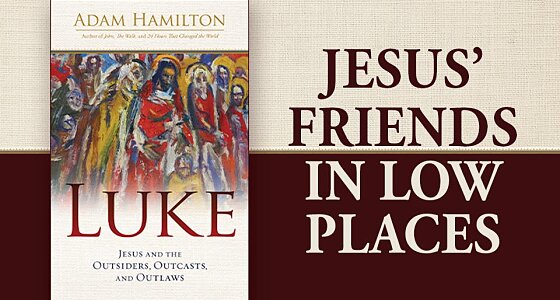
Adam Hamilton has written eight books with a ninth, Enough: Discovering Joy through Simplicity and Generosity, due for publication March of 2009. He is a regular contributor to Leadership Journal and has written numerous articles and position papers on issues ranging from church leadership, to Christian ethics. Adam’s sermons are also available through [...]
Speaking Engagements
Adam regularly speaks on leadership and faith in a variety of settings. We’ll be posting his upcoming speaking engagements after the first of the year. He also preaches each weekend at The United Methodist Church of the Resurrection in Leawood, Kansas. You can listen to his sermons here, or you can download [...]
General Motors and the UMC
General Motors just confirmed that it will eliminate it’s Pontiac division and reduce the number of dealerships by 42% in an attempt to avoid bankruptcy and to return to health and viability. I wonder what lessons there may be for the United Methodist Church in this announcement? One question that comes immediately to mind is: Does the UMC have too many “dealerships”? That is, do we really need 34,000 local churches with a denomination whose number of “customers” and “market share” has shrunk significantly in the last 40 years?
Could we do more to combine some of our churches into larger and more viable regional churches that, like the unified schools, bring communities together and offer services none of the smaller churches could offer? Where this is not possible, could we move to having more “tent-makers” as pastors in a large number of our smaller churches. “Tent-makers” are men and women who have a full time job that provides their primary source of income and health insurance, and then, like Paul (who was the original “tent-maker”) volunteer their time, or work for part time salary without benefits, to provide pastoral leadership for the smaller churches.
These are, of course, not new ideas. They are being done in a number of locations. But I wonder if its time to proactively, strategically and expeditiously move towards these models in places that otherwise might not consider it for another decade as a way of increasing the likelihood of creating vibrant and sustainable ministry in these locations? As a large number of our clergy retire over the next fifteen years this will become a practical necessity. Being proactive in this would also allow us to deploy many of our new young clergy to either creating new regional churches or launching entirely new congregations. A plan like this would also require our seminaries to focus their training on new church development and the leadership skills needed to combine churches into regional congregations. A simplified course of study might also be required for the tent-makers given that they will have full time jobs outside the church and may not be able to take time away to fulfill the requirements of the course of study.
Of course GM’s reducing the number of dealerships and closing the Pontiac division will not ensure its future viability. In the end this will depend upon their building great cars that people are excited about and which represent a great value. They’ve made strides in that direction in recent years. But it’s worth nothing that the structural changes are meaningless unless they offer a great product. Which points to the truth that structural changes in our denomination are only part of the issue. We can have the perfect structure, but if people walk into our churches on Sunday morning and the worship and preaching is uninspiring, the people unwelcoming, and the ministries of the church unimpactful, we will continue to decline. Churches with effective leaders, inspiring worship and preaching, and loving and compassionate congregations who reach out to their communities and seek to positively impact the world tend to grow.
The hope at GM is that the current moves will help the company emerge stronger and more viable, able to make great cars that people want to drive at a price that represents great value. The hope in whatever changes we might make in the UMC is that our denomination would emerge stronger, healthier and making a better use of our resources to further the work of Christ. But both GM and the UMC will have to work at ensuring that the “products” we offer are excellent and connect with the “consumer” we hope to reach. The alternative for GM, and for the UMC, is to keep doing the same thing we’ve been doing and to hope for different results.
What are your thoughts?
A Glimpse of the Future
This weekend was our Spring Confirmation weekend. On Friday night I met with our 136 confirmands to talk with them about what it means to be a Christ-follower and to invite them to commit their lives to him. As a part of this retreat each year I invite our young adults to consider a call to consider whether God may be calling them to serve as pastors, youth ministers, missionaries or other church professionals in order to reach their generation for Christ and to work to lead Christ’s mission in the world.
We had almost 40 youth who stood up at the retreat indicating a possible call on their lives. In our fall confirmation class there were another 50 or 60 who stood at the invitation. This represents 90 young adults from this year’s confirmation classes who are considering ordained ministry or full time work in the church or mission field. I am really excited about this!
I am convinced that the future of the United Methodist Church is largely dependent upon our existing churches inviting bright, gifted young people to answer God’s call to lead the church to reach their generation for Christ. The 80 largest churches in United Methodism have committed to help 1,000 young adults begin seminary in the next ten years. At last year’s Leadership Institute the churches in attendance committed to raise up another 500 young adults to begin seminary. What could God do with 1,500 bright, gifted, committed and passionate young adults? I believe they could be pivotal in turning the United Methodist Church from decline to a “future with hope.”
I just came from our confirmation service, laying hands on and anointing a number of these confirmands (many of whom I baptized as babies and presented third grade Bibles to - one of the joys of a long tenure in the pastorate). I look at these kids and I feel great hope for the church.
It’s been my experience that most people hear a call to ministry because someone they respect has suggested that they should consider ministry as a vocation. Have you suggested to any gifted young people you know that they should consider a call to ordained ministry? Does your church have a scholarship fund to help pay for seminary tuition?